Katja Hoffmann · 20 October 2026
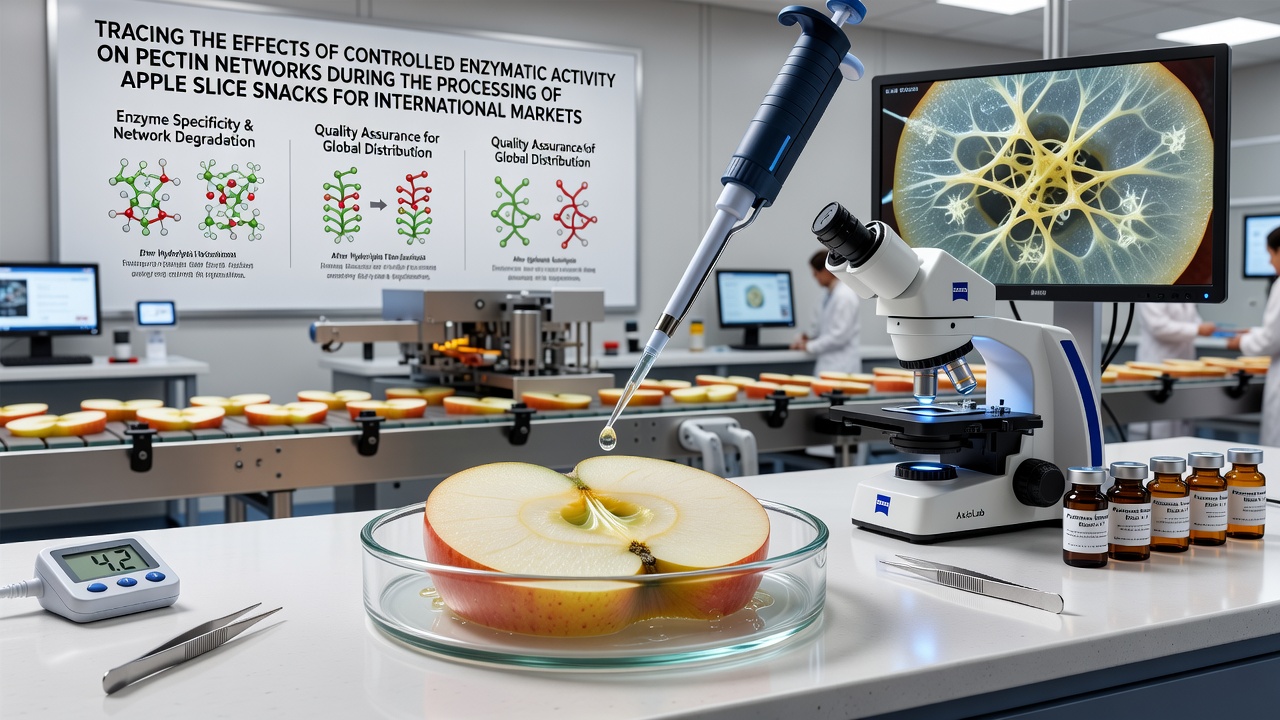
Tracing the Effects of Controlled Enzymatic Activity on Pectin Networks During the Processing of Apple Slice Snacks for International Markets
Controlled enzymatic activity plays a central role in shaping pectin networks within apple tissues during the production of dehydrated slice snacks destined for export. Pectin, a complex polysaccharide found in plant cell walls, provides structural integrity that processors modify through precise enzyme application to achieve consistent texture and extended shelf stability across global supply chains.
Fundamentals of Pectin Structure in Apple Processing
Apple varieties selected for snack production contain high levels of pectin primarily in the form of protopectin and soluble fractions; these molecules form gel-like networks that influence firmness after slicing and drying. Processors introduce enzymes such as pectin methylesterase and polygalacturonase under tightly regulated conditions to partially degrade or demethylate pectin chains, which alters water-binding capacity and prevents excessive softening during subsequent dehydration steps.
Studies from research institutions document how temperature, pH, and exposure duration determine the extent of network modification, with optimal ranges typically falling between 40 and 55 degrees Celsius and pH values near 4.5 for many commercial preparations. Data collected from pilot-scale facilities show that exceeding these parameters leads to over-hydrolysis and loss of desired crispness in final products.
Stage-by-Stage Application in Manufacturing Lines
Initial preparation begins with uniform slicing of apples followed by immediate immersion in enzyme solutions calibrated for specific activity levels. This step allows controlled penetration into intercellular spaces where pectin resides, and manufacturers monitor reaction kinetics using inline sensors that track viscosity changes in extracted samples. After enzyme treatment, blanching or mild heat inactivation halts activity to preserve targeted modifications before vacuum or convective drying commences.
International production facilities serving multiple markets coordinate these stages to meet varying moisture targets, often aiming for 5 to 8 percent residual water content that supports crisp texture without promoting microbial growth during long-distance transport. Records from facilities exporting to Asia and North America indicate that enzyme-treated batches maintain fracture force measurements within narrow tolerances even after six months of storage.

Regulatory Considerations for Global Trade
Exporters must align enzymatic processes with standards established by authorities in destination regions. The U.S. Food and Drug Administration maintains lists of approved enzymes and specifies usage levels for fruit products, while the European Food Safety Authority evaluates safety dossiers and sets maximum residue thresholds that influence formulation choices. In October 2026, several trade agreements incorporated updated guidelines on enzyme labeling for processed plant foods, prompting manufacturers to adjust documentation protocols for shipments to the EU and Canada.
Compliance documentation typically includes batch records detailing enzyme source, activity units applied, and inactivation verification results. Observers note that facilities supplying Australian and Middle Eastern markets additionally reference Codex Alimentarius provisions on processing aids to streamline customs clearance.
Analytical Methods for Network Evaluation
Quality control teams employ techniques such as high-performance liquid chromatography to quantify galacturonic acid release and atomic force microscopy to visualize pectin chain fragmentation after enzyme exposure. These measurements correlate directly with sensory attributes like crunch retention and rehydration behavior once products reach retail shelves in diverse climates. Research indicates that demethylation degrees between 40 and 60 percent often yield optimal balance between firmness and reduced stickiness in packaged slices.
Case examples from commercial operations reveal that integrating real-time spectroscopy during treatment stages reduces batch-to-batch variability by up to 25 percent compared with endpoint testing alone, supporting consistent performance across shipments to multiple continents.
Conclusion
Controlled enzymatic modification of pectin networks forms a documented component of apple slice snack manufacturing aimed at international distribution. Through regulated application of specific enzymes, defined processing parameters, and adherence to regional standards, producers achieve reproducible textural properties that withstand extended storage and transport requirements. Continued analytical monitoring and alignment with evolving trade specifications ensure these products meet technical criteria established by regulatory bodies worldwide.